No Protocol Reigns Supreme: Why Smart Cities Demand Hybrid Telemetry and Protocol-Agnostic Processing
1. The False Promise of “One Protocol to Rule Them All”
Smart city vendors and alliances routinely push the narrative that a single LPWAN protocol, be it Mioty, LoRaWAN, or NB-IoT, is capable of fulfilling all urban telemetry needs. This is a dangerously reductionist position. The promise of simplicity is seductive, but in reality, cities are complex, fragmented environments. Each protocol comes with hard limitations tied to physics, not preference.
Marketing teams often conflate protocol strengths in one context with universal superiority. What works in a flat rural district with clear line-of-sight fails miserably in a dense urban core or underground infrastructure. Engineering choices should be driven by terrain, RF density, and deployment context, not corporate allegiance.
2. Landscape Matters: Urban, Suburban, and Rural Incompatibilities
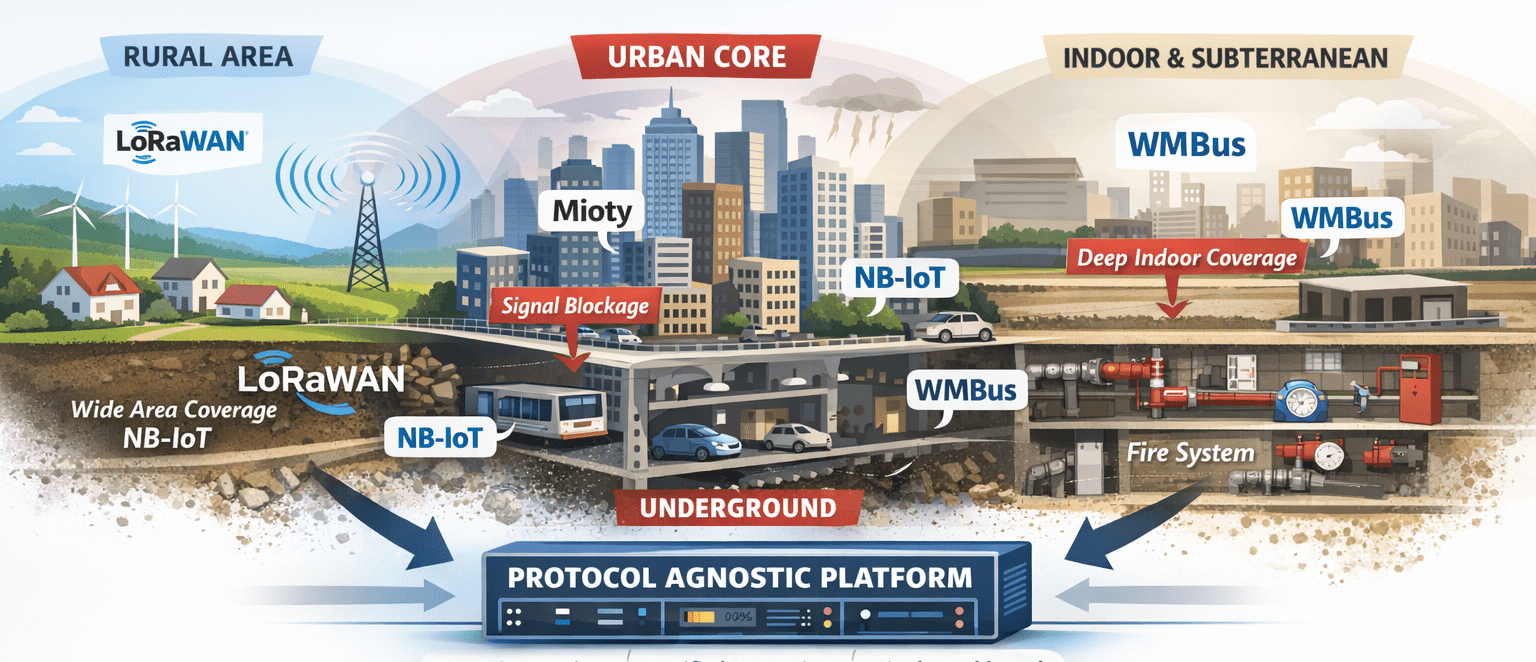
City layouts are not homogeneous. A suburban neighborhood with spaced homes and open terrain offers ideal conditions for long-range protocols. But these same technologies break down when confronted with multi-level parking garages, basements, metal shafts, or the RF shadow of high-rises.
- Urban cores: Concrete, steel, and glass cause multi-path interference, shadowing, and attenuation. Protocols relying on free-space propagation suffer drastically.
- Underground systems: Fire meters, water mains, and parking systems are located below grade. RF penetration is weak or nonexistent without relays or purpose-built radios.
- Rural zones: Wide coverage is essential, favoring low-power, long-range protocols with high link budgets.
There is no one-size-fits-all. City planners must treat radio coverage like infrastructure planning, it must conform to geography, not ideology.
3. Protocol Performance Is Environmental, Not Absolute
Each LPWAN protocol has a strength—but also a failure point. Here’s the reality:
| Protocol | Best Use Case | Fatal Limitation |
|---|---|---|
| NB-IoT | Licensed spectrum; rural deployments | Ineffective underground or in dense cores without relays |
| LoRaWAN | Minimal infrastructure; rural/metropolitan use | Suffers in dense urban, deep-indoor environments |
| Mioty | Noisy spectrum, scalable, mobile nodes | High startup cost, unproven in underground deployments |
| WMBus | Deep-indoor utility metering | Limited range, gateway-dependent for long-haul |
Protocol selection must be dictated by real-world constraints—not sales material.
4. Terrain, RF Density, and Line-of-Sight Are King
RF propagation is dictated by physics:
- Reflections and diffraction from steel, concrete, and glass distort signal paths.
- Attenuation increases drastically with every wall, floor, or meter of dirt.
- Dynamic interference from traffic, people, and weather introduces instability.
A city is not a lab. Models fail when confronted with physical complexity. Smart infrastructure must be designed with these dynamics in mind.
5. Real Cities Need Real Architectures, Not Tech Evangelism
This is where most smart city projects fail: they choose a protocol, not a platform. Engineers argue protocol supremacy, while the city ends up with siloed systems, vendor lock-in, and redundant infrastructure.
A viable architecture uses multi-protocol ingestion at the edge and defers normalization and processing to a central, protocol-agnostic core. This avoids:
- Multiple billing and vendor contacts
- Incompatible schemas and dashboards
- Legal risk through fragmented data handling
6. The True Role of Infrastructure: A Platform, Not a Protocol
What cities truly need is not a protocol preference, but a unified telemetry processor. One that:
- Ingests LoRaWAN, Mioty, NB-IoT, WMBus, BLE, and more
- Normalizes all data into a single schema
- Provides legal traceability and GDPR compliance
- Enables correlation, alerts, analytics, and long-term storage
KRONYX is an example of such a processor. It exists above the radio layer and turns fragmented inputs into operational intelligence. In this model, sensors are dumb. The platform is smart.
7. Final Word: Radio is Local, Infrastructure Must Be Global
RF behavior is dictated by geography, terrain, and topology. Protocol wars ignore this. No sensor protocol should be forced to work outside its optimal environment. Instead, the processing layer must be designed to absorb diversity and unify outcomes.
That is the future of Smart Cities: Protocol diversity. Infrastructure unity. Real-world results.