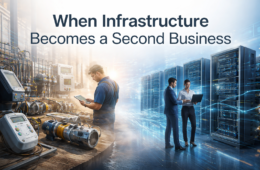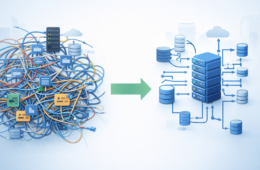
When Infrastructure Becomes a Second Business
In recent years, many established submetering firms have taken a decisive step toward digital independence. Data collection moved in-house. Processing layers were expanded. Dashboards were built. Internal engineering teams grew. What began as modernization gradually became ownership.
At first, this felt like progress.
Digital capability promised control. Less reliance on external vendors. Faster feature rollout. Greater responsiveness to regulatory pressure. For companies that had mastered hardware logistics, billing precision, and long-term customer trust, building internal systems seemed like the natural next stage of evolution.
But something subtle has happened in some organizations.
Infrastructure is no longer supporting the business. It is quietly becoming one.
Submetering companies have spent decades perfecting a very specific discipline. Device rollout. Calibration cycles. Contract management. Housing association relationships. Regulatory alignment. Billing integrity. These capabilities were not improvised. They were built over years, often generations, through iteration and operational learning.
Digital processing is a different discipline.
It has its own scaling logic. Its own failure modes. Its own economics. Its own compliance exposure. It requires not just software development, but architectural depth that anticipates growth before it becomes visible on revenue charts.
The transition into this discipline has often been faster than the preparation for it.
Hiring one or two experienced developers does not create a processing organization. Extending an internal platform does not automatically create architectural resilience. Expanding monitoring tools does not eliminate structural fragility. Yet these steps can create the impression that the digital layer is under control.
Over time, the signs of strain begin to appear.
Engineering discussions shift from innovation to stabilization. Scaling requires coordination rather than architecture. Sales hesitates before committing to aggressive growth targets because backend capacity is not entirely predictable. Compliance reviews demand deeper traceability than originally designed. Small edge cases consume disproportionate attention.
None of this signals failure. It signals weight.
The weight of operating a processing layer at scale is rarely modeled at board level. Revenue per meter is predictable. Backend obligation is not. As device diversity increases and regulatory scrutiny deepens, the digital surface area expands independently of portfolio size.
Under GDPR, processor responsibility is not abstract. Data custody is structural. Auditability must be demonstrable. Traceability must withstand scrutiny beyond internal assurance. In Germany, regulatory expectations are not static. They evolve. The processing layer becomes a liability surface, not just a technical component.
This is where the identity tension begins.
Many submetering firms view internal platform ownership as a sign of strength. It reinforces independence. It reflects ambition. It suggests technological maturity. After decades of mastering physical infrastructure, building digital infrastructure feels like the logical continuation of control.
But control and capability are not the same.
Hardware excellence is built on operational repetition and incremental refinement. Processing excellence requires anticipating scale, concurrency, fault behavior, and legal defensibility before problems surface. It demands architectural foresight that is not naturally embedded in organizations whose core expertise lies elsewhere.
When both disciplines are pursued without explicit separation, the organization stretches.
Leadership attention is divided. Engineering hiring becomes reactive. Infrastructure decisions are made under commercial pressure rather than structural planning. Incremental extensions replace foundational redesign. The company begins operating two businesses, even if only one appears on the balance sheet.
This is not an argument against digital ownership. Digital capability is no longer optional in submetering. Customers expect visibility. Housing associations expect data access. Regulatory frameworks expect structured accountability. The question is not whether digital infrastructure is necessary. It clearly is.
The question is whether operating a telemetry processing engine is intended to be a core strategic identity, or whether it has emerged by default.
In mature industries, specialization increases over time. Manufacturing separates from financing. Logistics separates from retail. Utilities separate generation from distribution. This separation does not weaken companies. It clarifies them.
Submetering now faces a similar structural decision. As portfolios scale and compliance depth increases, the processing layer demands the rigor of a utility. Predictable scaling behavior. Clear audit reconstruction. Stable cost curves. Long-term architectural discipline. These are not software features. They are structural commitments.
If a firm chooses to operate that layer internally, it must invest accordingly and accept that it is building a second industrial discipline. If it chooses to separate it, the boundary must be deliberate and strategically defined.
What becomes risky is not either choice. What becomes risky is drifting into operating a second business without acknowledging that it exists.
Many executives sense this tension already. The question is whether it remains an operational irritation or becomes a strategic decision.
Is digital infrastructure still a support function for the meter business, or has the company quietly committed to becoming a processing utility as well?